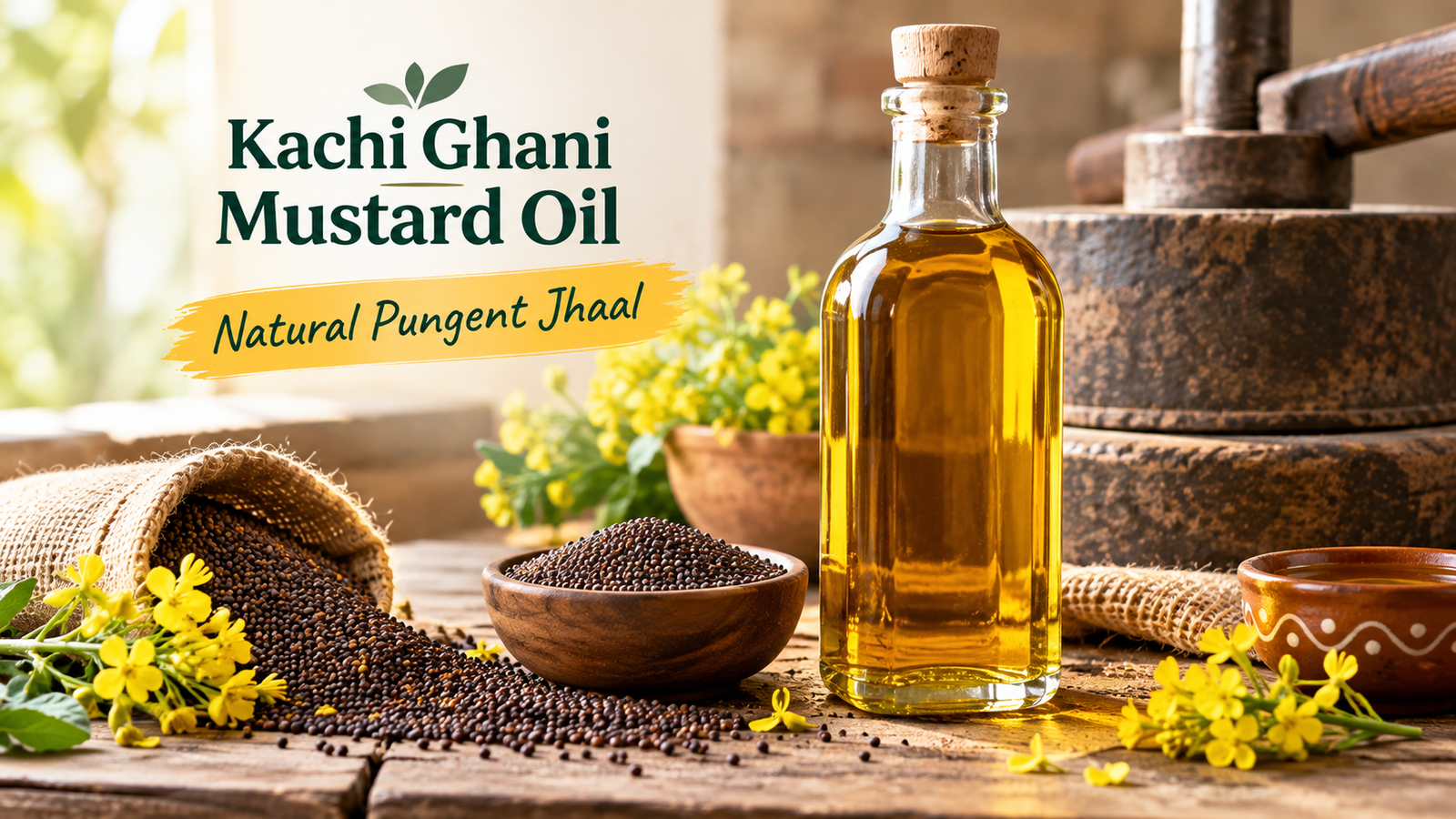
If you have ever tasted authentic mustard oil, you probably know the unmistakable “jhaal”—that sharp, warm, nose-tingling sensation that makes mustard oil different from many other cooking oils.
But why does real Kachi Ghani mustard oil have natural pungent jhaal?
The answer lies in the mustard seed itself. Naturally occurring compounds in mustard, including glucosinolates and their breakdown products such as allyl isothiocyanate (AITC), contribute strongly to mustard's characteristic pungency and aroma. FSSAI specifically identifies allyl isothiocyanate as responsible for the pungent flavour of mustard oil.
What Gives Mustard Oil Its Natural Jhaal?
Mustard seeds naturally contain compounds called glucosinolates. When mustard seed tissues are disrupted during processing, an enzyme called myrosinase helps convert these compounds into pungent breakdown products, including isothiocyanates.
Allyl isothiocyanate is particularly important because it produces the familiar sharp, spicy sensation associated with mustard. Scientific literature describes isothiocyanates as major contributors to the hot and pungent character of mustard.
In simple words:
Mustard seeds → natural glucosinolates → processing → pungent compounds → characteristic mustard jhaal
This is why the aroma and heat of mustard oil are not simply a flavour added from outside—they can originate from the mustard seed itself.
Why Does Kachi Ghani Mustard Oil Taste So Sharp?
“Kachi Ghani” refers to mustard oil produced through an expeller/cold-pressed process rather than conventional solvent extraction followed by refining.
FSSAI regulations specify that an oil may be labelled “Kachi Ghani” or “Cold Pressed” when its natural allyl isothiocyanate content is at least 0.20% by weight.
FSSAI's edible-oil survey also notes that Kachi Ghani/cold-pressed mustard oil is expected to be rich in naturally occurring allyl isothiocyanate and identifies AITC as responsible for mustard oil's pungent flavour.
Therefore, a noticeable natural jhaal can be one of the sensory characteristics people associate with traditional mustard oil.
Does More Jhaal Always Mean Better Mustard Oil?
Not necessarily.
Pungency can vary because mustard varieties differ in their glucosinolate composition. Processing conditions can also influence the compounds responsible for aroma and pungency. Research shows that mustard species and processing conditions can affect the intensity and character of the final flavour.
So, jhaal should not be treated as the only measure of oil quality.
Consumers should also consider the source of the mustard seeds, processing method, freshness, packaging, storage and applicable food-safety standards.
Why Is Natural Jhaal Important in Indian Cooking?
Mustard oil's pungent aroma is closely associated with many Indian regional cooking styles. Its distinctive character can complement dishes such as pickles, marinades, curries, fish preparations and traditional vegetable recipes.
For people looking specifically for the characteristic flavour of traditional mustard oil, choosing a properly labelled product and understanding its processing method can be more useful than simply judging the oil by colour.
If you are looking for Kachi Ghani mustard oil, you can explore Grandma & Son Mustard Oil, where the product information can help you understand the oil and its intended use.
How Can You Identify Authentic Kachi Ghani Mustard Oil?
Start by checking the product label and relevant food information rather than relying only on smell or colour.
Look for:
* Clear product and ingredient information- * Appropriate food-safety and regulatory details
- * Processing information such as Kachi Ghani/cold pressed
- * Proper packaging and sealing
- * Batch and date information
- * Reliable sourcing and storage practices
A strong pungent aroma can be characteristic, but it should not be used alone to prove authenticity.
Conclusion
The natural jhaal of Kachi Ghani mustard oil comes largely from mustard's naturally occurring chemistry. Glucosinolates in mustard seeds can break down into pungent compounds, with allyl isothiocyanate playing an important role in the characteristic sharp flavour and aroma.
That distinctive heat is one reason mustard oil remains an important ingredient in traditional Indian cooking.
If you want to learn more about sourcing or enquire about mustard oil, you can contact Grandma & Son for mustard oil.
Frequently Asked Questions
1. What causes the jhaal in mustard oil?
Natural compounds derived from mustard seeds, especially allyl isothiocyanate, contribute significantly to mustard oil's characteristic pungent flavour.
2. Is pungent jhaal natural in Kachi Ghani mustard oil?
Yes. FSSAI identifies naturally occurring allyl isothiocyanate as responsible for mustard oil's pungent flavour and specifies a minimum natural AITC level for the Kachi Ghani/cold-pressed label.
3. Does stronger jhaal mean better quality?
Not necessarily. Pungency varies with mustard variety and processing. Quality should be assessed using the complete product information, sourcing, processing and food-safety details.
4. Why does mustard oil feel sharp in the nose?
Pungent isothiocyanates can stimulate heat and acidity-sensing receptors, producing the familiar sharp sensation associated with mustard.
5. What is Kachi Ghani mustard oil?
It is a mustard oil category associated with expeller/cold-pressed processing. Under FSSAI's cited specification, natural allyl isothiocyanate must be at least 0.20% by weight for the oil to be labelled Kachi Ghani or Cold Pressed.